Cortina, Courmayeur & Val Gardena: Italy has no shortage of ski resorts, but these three destinations sit above the rest — not merely as ski areas, but as complete winter propositions.
Cortina d’Ampezzo, often hailed as the Queen of the Dolomites, has just hosted the 2026 Winter Olympics, cementing its position as the most talked-about ski destination in Europe.
Courmayeur ranks among Italy’s most expensive and elite ski resorts, perched at the foot of Mont Blanc with the French border practically at its doorstep.
And Val Gardena — recently ranked by Lonely Planet as the best ski resort in Europe — sits at the heart of the Dolomiti Superski empire, a gateway to skiing on a scale few resorts anywhere can match.
Three entirely different propositions. The same question: which one is right for you?
Table of Contents
Cortina d’Ampezzo — The Theatre of the Dolomites
The skiing
Cortina’s three main ski areas — Tofana-Socrepes, Faloria-Cristallo, and Cinque Torri e Col Gallina/Lagazuoi — are linked by buses, lifts and pistes, adding up to 120km of considerable variety. The honest assessment is that Cortina is not chosen for kilometre counts. It is chosen for the experience of skiing inside a UNESCO landscape so dramatic that the mountains feel theatrical rather than merely scenic.
The Tofana-Socrepes area is the resort’s workhorse — wide, well-groomed, and surprisingly accessible for mixed-ability groups. The extensive lower slopes above Socrepes are the best area for beginners and timid intermediates, while the upper Tofana slopes include tough red runs and the extraordinarily scenic Forcella Rossa black run. For those seeking something rawer, the Cinque Torri sector holds some of the finest off-piste in the entire Dolomites — the Bus de Tofana descent is spoken about in reverent terms by local mountain guides.
One practical caveat worth knowing: reaching Tofana-Socrepes and Cinque Torri-Lagazuoi from the town centre requires either a walk or a bus ride. The areas are not ski-in ski-out from the village in the way Courmayeur or Val Gardena can be. Hotel choice matters considerably here — proximity to the correct cable car base changes the quality of the skiing day entirely.
The village
Cortina’s cobblestoned centre is dotted with stylish hotels, restaurants, and shops, anchored by Corso Italia — a pedestrian zone that functions as the social stage for the entire resort. The Dolce Vita atmosphere is genuine, not performed. This is where wealthy Italians come to be seen, and the level of style on the slopes and off them reflects that.
The main drag has remained largely unchanged despite big international brands setting up alongside long-established local businesses. Enoteca Cortina is the insider’s wine bar of choice — a place where locals and discerning visitors coexist over exceptional glasses poured from serious bottles. Hotel de la Poste, particularly its original bar, is a timeless address that predates the Olympic era and remains Cortina’s most atmospheric aperitivo stop.
For dining, the insider instruction is simple: book early and plan around lunch rather than dinner. The mountain rifugi here are the real draw — Rifugio Averau at Cinque Torri delivers proper Italian food at altitude in a setting of near-absurd Dolomite grandeur.
The hotels
Cortina has undergone significant transformation in preparation for the 2026 Winter Olympics — new hotels, new gondolas, and substantial infrastructure investment across the resort. Hotel l’Ancora, first opened in 1826 and recently renovated under Diesel founder Renzo Rosso’s ownership, is now a design-forward address with a spa and cell-phone-free nightclub directly on the Corso Italia. Hotel Tofana, opened December 2024, sits on the slopes with the largest spa in town and direct views over the women’s Olympic racecourse. The historic Cristallo is set to reopen under the Mandarin Oriental umbrella, adding international five-star credentials to a property that already carries considerable heritage.
Who it suits
Cortina rewards independent-minded travellers who want their skiing woven into a broader cultural and social experience. It does not suit those seeking effortless, everything-flows days on the mountain. It suits those for whom the mountain is part of a larger picture — scenery, food, aperitivo, architecture, and perhaps a black run thrown in for good measure.
Courmayeur — Italian Elegance at the Foot of Europe’s Highest Peak
The skiing
Courmayeur’s Checrouit-Val Veny ski area covers 100km of pistes draped over a long ridge immediately west of the town, accessible by cable car from the village centre or by gondola from the adjacent suburb of Dolonne. The numbers suggest something modest; the reality is considerably more interesting.
The resort divides into two distinct sectors: the open, sun-exposed Checrouit slopes and the steeper, tree-lined Val Veny terrain with its spectacular views across the Mont Blanc glaciers. Advanced skiers and freeriders prize Courmayeur above all for its off-piste opportunities — including the legendary Vallée Blanche descent towards Chamonix, one of the great mountain experiences in the Alps. This is the critical distinction: Courmayeur’s headline skiing statistic understates the resort’s appeal entirely. With a guide and the right conditions, the off-piste terrain here is among the most serious in the Alps.
The Mont Blanc Unlimited pass expands access to Chamonix Valley, the Evasion Mont-Blanc area around Megève, and Italian neighbour La Thuile — suddenly, 100km becomes a multi-resort circuit of real ambition. The Skyway Monte Bianco cable car deserves particular mention: rising to 3,466 metres with a 360-degree rotating panorama culminating at Punta Helbronner, non-skiers consider this alone worth the trip. Skiers use it as a launch point for high-mountain descents that have no equivalent elsewhere in Italy.
The village
Courmayeur is effortlessly chic — the weekend destination of choice for wealthy Milanese and Torinese, including figures like Dolce & Gabbana who own houses here. Via Roma is the shopping artery: Gucci, Prada, Armani, and Moncler alongside the jeweller Aurum. The village’s cobbled streets and wooden balconies carry genuine Alpine character without straining for effect — this is a resort that has always known what it is.
The food culture here is exceptional even by Italian standards. Courmayeur’s restaurants are so acclaimed that fashionable Italians travel here specifically for gourmet ski breaks — being seen at the right address matters as much as the skiing. Maison Vieille at the top of its namesake chairlift is the mountain dining reference: roast suckling pig, a trio of pasta dishes, and the kind of unhurried service that turns a lunch into an afternoon. In the village, Pierre Alexis 1877 carries Michelin recognition for its seasonal, locally foraged menu. For aperitivo with energy, the Super G on the slopes delivers a terrace atmosphere that Cortina’s more reserved character never quite permits.
The hotels
Grand Hotel Courmayeur Mont Blanc delivers modern alpine luxury with floor-to-ceiling mountain views and serious spa facilities. Auberge de la Maison in Entrèves — a short drive from the main village — is the insider’s choice: intimate, Valdostan in character, and positioned perfectly for the Val Ferret valley, where cross-country skiers find a quieter, unhurried Courmayeur. For families, Hotel Gran Baita offers the full Valdostan wood-and-stone aesthetic, a heated outdoor pool, and a shuttle service to the lifts. Those seeking the ultimate address should note that Le Massif, a five-star property close to the lifts, consistently tops the resort’s luxury rankings.
Who it suits
Courmayeur is for the skier who wants serious terrain without compromising on the quality of the evening. It suits those who treat food and skiing as equal pleasures — who want a Michelin-referenced mountain restaurant and the possibility of a genuine off-piste adventure with a guide on the same day. It is also the most international of the three resorts, drawing French, British, and Swiss visitors alongside its Italian core clientele.
Val Gardena — The Dolomites at Their Most Complete
The skiing
Val Gardena is the umbrella name for a string of villages — Ortisei, Santa Cristina, and Selva — in the heart of the Dolomites, with direct access to the Sella Ronda circuit and the vast 1,200km Dolomiti Superski area. If skiing volume is the priority, nothing in Italy comes close.
The Sella Ronda is the resort’s signature experience and one of the great ski days in Europe. A 26km circuit circling the Sella Massif and crossing four mountain passes and four valleys, it can be skied comfortably in a day in either direction. The food along the way is so compelling that local advice is to set out by 10am to avoid being stranded in the wrong valley when the lifts close around 4pm. The clockwise orange route is sportier and slightly faster; the green counterclockwise route is more varied in terrain and arguably more scenic.
Selva di Val Gardena sits directly on the Sella Ronda circuit and carries the largest concentration of ski-to-door hotels — making it the most straightforward base for those who want seamless days on the mountain. The Saslong World Cup piste above Santa Cristina is a genuine test for strong intermediates; the Seceda area above Ortisei delivers some of the most spectacular descents in the Dolomites, with views across the valley that stop skiers mid-run.
Val Gardena is a superb piste destination rather than a significant powder resort, but the Forcella Mezdì and Forcella del Pordoi access beautiful deep-snow descents for those willing to explore beyond the circuit. The resort’s snow reliability is exceptional — 98% of slopes have snowmaking capability, ensuring consistent conditions from early December through April.
The village
Val Gardena operates across three distinct villages, each with a different character. Ortisei is the largest and most atmospheric — a pedestrianised centre with proper shops, galleries, and the cultural depth that comes from being the valley’s historic capital. Santa Cristina sits in the middle, carrying the quietest and most residential character. Selva is the highest village, with the most dramatic mountain views and the most direct access to the Sella Ronda circuit.
The cultural identity here is genuinely distinctive. Val Gardena sits in South Tyrol and carries the influence of three cultures — Italian, Austrian, and the indigenous Ladin tradition — in its food, architecture, and language. The après-ski culture is more geared to eating than drinking, which given the quality of the mountain huts, is entirely the right priority. The Emilio Comici rifugio near Passo Sella is a resort institution — gourmet cuisine at 2,154 metres, with seafood sourced daily from the Adriatic, delivered to the mountain each morning. La Stua in Selva is the valley’s liveliest après-ski bar. For serious dining, Anna Stuben in Ortisei carries Michelin credentials and represents the finest end of Ladin-Tyrolean cuisine.
The hotels
Hotel Granbaita Dolomites in Selva is the valley’s five-star benchmark — lavish rooms, an extensive spa with seven saunas and an indoor-outdoor pool, and tasting menus that hold their own against the valley’s standalone restaurants. For those prioritising ski access above all, Hotel Freina sits directly on the Ciampinoi slopes with genuine ski-in ski-out convenience. In Ortisei, Gardena Grödnerhof combines luxury-level spa facilities with the warmth of a family-run hotel that has accumulated genuine character over generations. Those seeking something more intimate should consider Chalet Elisabeth in Selva — a boutique property directly opposite the Sella Ronda access lift, where personalised service compensates for what it lacks in scale.
Getting there — and why Venice changes the equation
Val Gardena’s closest airport is Bolzano, just 50km and under an hour by road — though Bolzano’s flight connections remain limited. The more practical gateway for international visitors is Venice Marco Polo, approximately 185km and around three hours by car. That driving time is not a disadvantage — it is an opportunity. Venice and Val Gardena make a genuinely compelling combined itinerary: two or three nights in one of Europe’s most extraordinary cities, followed by a week of skiing in the heart of the Dolomites.
For families travelling from the UK, Scandinavia, or Northern Europe, this is a trip that justifies itself twice over. Fly into Venice, spend time in the city, collect a hire car, and drive north into the mountains. Few winter itineraries in Europe offer that quality of contrast.
Who it suits
Val Gardena is the most complete family resort of the three. The Alpe di Siusi area, connected from Ortisei, offers the gentlest terrain in the region — ideal for children learning to ski in an environment that doesn’t intimidate. It is also the resort for those who want to ski the greatest possible area from a single base without logistical complexity. Every morning, the mountain is simply there — the lifts leave from the village, the Sella Ronda is signposted, and the day takes care of itself.
The Verdict: Which Resort Is Right for You?
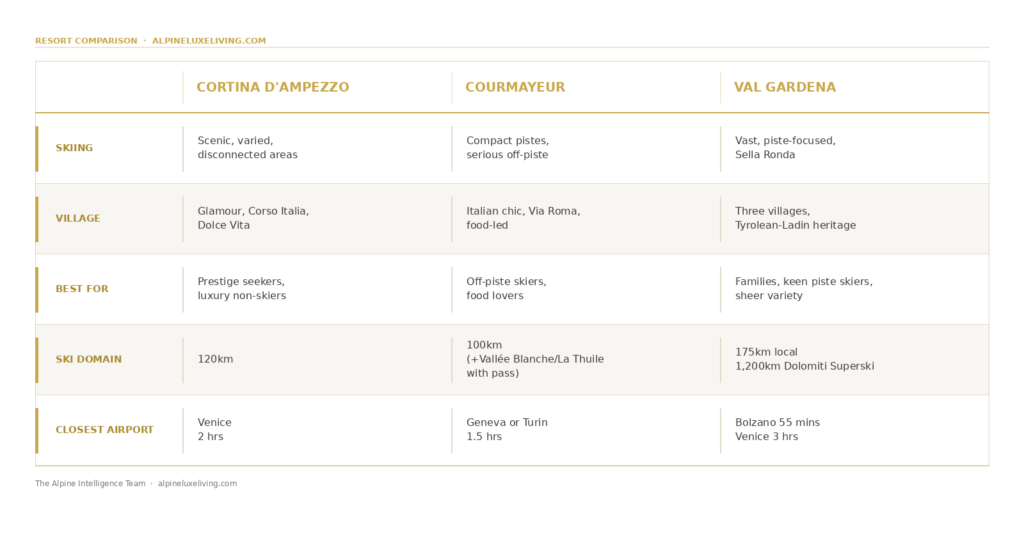
Italy’s ski resorts are not a single answer. Cortina is theatre — it demands engagement and rewards with an experience that exists nowhere else on the continent. Courmayeur is connoisseurship — it suits those who know exactly what they want and find it, quietly and elegantly, at the foot of Europe’s highest peak. Val Gardena is abundance — a resort where the mountain itself provides the structure, and the only real decision each morning is which direction to ski the circuit.
Cortina, Courmayeur & Val Gardena belong on the list of Europe’s great winter destinations. The question is simply which of those three propositions speaks to the winter you want to have.
For further reading, explore the AlpineLuxeLiving guide to Verbier vs Zermatt — Switzerland’s Two Greatest Resorts.